


Team Building
The Silent Majority: What It Really Means When Agents Don’t Close a Deal

The Silent Majority: What It Really Means When Agents Don’t Close a Deal

Let’s talk about something most broker-owners, recruiters, and team leaders know but rarely address out loud: a staggering number of licensed real estate agents haven’t closed a single transaction this year.

That’s not hyperbole. It’s backed by data. In many markets, 30 to 40 percent of licensed agents have recorded zero closings in the first half of the year. Let that sink in. These aren’t brand-new agents still learning the ropes. Many have been in the business for years, some even with robust past track records. So what’s going on?

It’s Not Just the Market—It’s the Mindset

Yes, interest rates are high. Yes, inventory is low. But the agents who are closing deals aren’t waiting for market conditions to improve. They’re adjusting. They’re prospecting. They’re refining their message. They’re building trust.

So what separates the doers from the dormant?

Behavior. Motivation. Emotional resilience.

This is where we come in.

At The Abelson Group, we’ve spent over 35 years analyzing high-performing agents through the lens of DISC, Motivators, and Emotional Intelligence. The truth is, agents who are stuck often don’t have a skill problem. They have a behavioral blind spot. Or they’re internally misaligned with what drives them. Or they simply don’t have the emotional awareness to self-correct.

The Cost of Inaction

For brokerages, unproductive agents aren’t just invisible—they’re costly. They dilute brand reputation, drain leadership energy, and silently negatively impact the office. The real cost isn’t just missed commissions. It’s missed momentum and opportunity.

And for agents? Every month without a transaction is a silent hit to confidence. That internal narrative of “maybe this isn’t for me” gets louder.

So What Can You Do?

Stop guessing. Start assessing.  Stop waiting for things to change.  Identify strengths and change behavior to capitalize on those strengths.   

When you use the Abelson DISC and Motivators assessments, you don’t just get colorful charts. You get insights that uncover exactly where someone is stuck and how to move them forward. When you layer in another personality dimension we measure, Emotional Intelligence, you start to understand how they respond under stress, where they deflect, and what kind of support they actually need.

Here’s the good news: every unproductive agent has potential. But potential without insight and action is just potential.

If you want your people to close more transactions, help them close the gap between who they are and what they need to succeed.  Use our assessments to give you guidance on what to change and how to change to capitalize on strengths and minimize limitations.

Doing More with the Team You Already Have

Doing More with the Team You Already Have

In today’s market, hiring isn’t always the solution—and quite frankly, sometimes it’s a distraction. The real win? Getting more out of the people you already have.

Now, I don’t mean working them harder. I mean working smarter—together.

The organizations thriving in the current market aren’t the ones throwing bodies at problems. They’re the ones using behavioral data to align their people, improve communication, and reduce inefficiencies. They understand that productivity doesn’t come from pushing—it comes from positioning.

A Misaligned Team is an Expensive Team

When your team’s behavioral styles are in conflict, communication gets messy. Tasks get repeated. Frustration sets in. Suddenly, projects take twice as long—and morale takes a hit.

But when you understand how your people are wired—how they naturally lead, follow, communicate, and decide—you can design your team to thrive.

This is what we do every day with the DISC and Motivators Abelson Report.

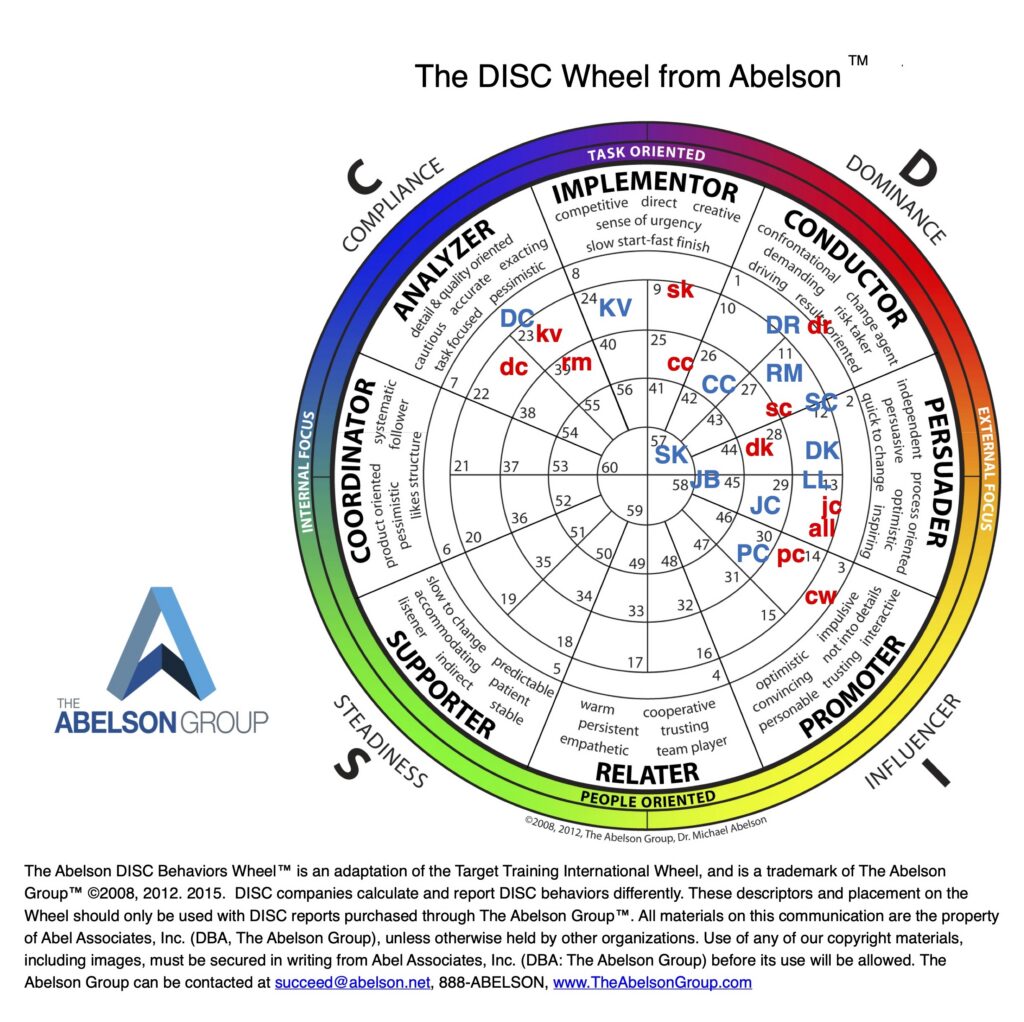
We don’t just hand you a report. We help you place your people on the Abelson Team Behaviors Wheel so you can see the blind spots, overlaps, and missing links in your current team dynamic.

Sometimes the fix isn’t hiring someone new—it’s realigning roles, shifting communication styles, and giving the right people the right tools.

Efficiency Doesn’t Mean “Do More.” It Means “Do Right.”

If your instinct is to add more to someone’s plate, pause. Ask instead:

  • Are they in the role that fits their strengths?
  • Are they motivated by what they’re doing?
  • Are we communicating in a way they actually hear?

This is where assessments become very powerful. A skilled team building facilitator can use the Abelson Wheels to give leaders clarity of the behaviors of all the people in their team—and clarity drives efficiency.

Ready to Optimize Your Team?

Whether your business is in growth mode or holding steady, optimizing your current team might be the most profitable move you make.

Let’s talk about how we can map your team’s behavior and motivators on the Abelson Team Wheel and the Abelson Report, so you can lead with strategy—not guesswork.

Visit www.theabelsongroup.com/teams to learn more or to schedule a discovery call. See why The Abelson Group is the cover story of the July 2024 issue of Manage HR Magazine as the top team building service provider in the USA.

To better teams and better outcomes,
Dr. A
Founder, The Abelson Group

Why Smart Teams Use DISC & Motivators to Perform at a Higher Level

Why Smart Teams Use DISC & Motivators to Perform at a Higher Level

Over the last 45+ years working with leaders and organizations across the globe, I’ve seen a common thread in underperforming teams: they have the skills, the experience, and even the ambition—but they don’t understand each other.

Great teams aren’t just built on talent. They’re built on clarity of behavior and alignment of motivation. That’s where the DISC and Motivators Assessments, used by The Abelson Group, makes all the difference.

Let’s talk about why this matters—and how it changes the game for any organization willing to look beyond the resume.

You’re Not Managing People. You’re Managing Patterns.

The real challenge in leading a team is not managing tasks—it’s managing behavioral patterns. Who communicates directly? Who avoids conflict? Who thrives in change? Who resists it?

Our version of the DISC Assessment captures both Natural and Adaptive behaviors—so you’re not just seeing how someone acts on a good day, but how they adjust under stress or pressure. That insight is gold when you’re trying to navigate deadlines, personality clashes, or high-stakes decisions.

When you combine that with Motivators, you now understand why someone acts the way they do. Are they driven by logic, loyalty, influence, innovation? You don’t have to guess anymore.

The DISC Wheel: A Snapshot of Team Dynamics

One of the most useful tools I use with teams is the Abelson DISC Behaviors Wheel. It allows you to visually place every team member on a single graphic, based on their dominant behavioral traits.

Why does this matter?

Because you can now see where your team is strong—and where you may have gaps. For example:

  • Too many High Ds? You’ve got energy and drive—but you might lack harmony or detail-orientation.
  • All High Cs? You’ve got precision—but may stall when it comes to fast decision-making or innovation.
  • Missing High Is? You may struggle with influence and group morale.

Once a team is placed on the wheel, patterns emerge. Leaders can realign responsibilities, identify who to coach differently, and—importantly—see where future hires should complement the current group.

The DISC Wheel makes the abstract visible, and in leadership, that’s a major advantage.

Why Motivators Matter Just as Much

Understanding behavior is only part of the equation. If you want to keep your people engaged and fulfilled, you need to understand what drives them.

Some team members are driven by recognition. Others by autonomystructureservice, or intellectual challenge. When those internal values are not acknowledged—or worse, are in conflict with how they’re being managed—people disengage.

Our Motivators Assessment allows you to align leadership, coaching, and even incentives with the unique inner drivers of each team member. This turns leadership into a strategic process, not a guessing game.

Conflict Doesn’t Have to Be Costly

Many organizations come to us because their team is experiencing conflict. What I always tell them is this: conflict is not the enemy—misunderstanding is.

When teams understand the behavioral and motivational profile of their teammates, conflict often turns from emotional reaction to professional dialogue.

Instead of “She’s just difficult,” we hear, “She’s a High C under stress and needs more data to feel confident.” That reframing alone can save projects, performance, and people.

The End Goal: Predictable, Sustainable Performance

Using DISC and Motivators doesn’t just make teams feel better—it makes them perform better. Consistently.

You can:

  • Communicate more clearly
  • Assign responsibilities more strategically
  • Create development plans that actually stick
  • Retain the right people
  • Hire more intelligently

And you can do all of this with less trial and error.

Final Thought

People are the most valuable—and most complex—part of any organization. If you don’t understand how they behave and what drives them, you’re flying blind.

At The Abelson Group, we’ve spent decades using and showing our clients how to use tools that don’t just describe people—they equip leaders to get results through people.

If you’re serious about building a team that doesn’t just function—but flourishes—DISC and Motivators will give you the roadmap and we will be your guide.

Let us help you make the invisible visible and the impossible doable!

What Makes Teams Effective in Times of Uncertainty – LIKE NOW?

What Makes Teams Effective in Times of Uncertainty – LIKE NOW?

United States tariffs are increased on countries worldwide and then decreased!  Stock markets and bond markets go up and down and up again!  Industries go on hiring binges and then do wholesale layoffs.  The technology industry, for example, has done this numerous times.   They escalate salaries and have “hiring wars,” only to have wholesale layoffs and year or so later.   We all have specific examples of how our world has turned uncertain.

read more…
Resolving Team “Pressure Points”

Resolving Team “Pressure Points”

There are many different types of teams; executive teams, administrative teams, project teams, taskforce teams, sales teams… Teams can be from many different types of organizations; for-profit, not-for-profit, community service, even family. There is one thing that ALL teams experience; pressure points. How a team identifies and deals with stressors, conflicts, personality
clashes, and other dynamics often spells the difference between success and failure.

read more…

Pin It on Pinterest