


DISC
Smart Leaders Aren’t Just Managing People. They’re Aligning Them.

Smart Leaders Aren’t Just Managing People. They’re Aligning Them.

Let’s face it: this market demands more with less.

And while it’s tempting to think that hiring someone new will solve your productivity problem, most of the time, it won’t. The smartest leaders I work with aren’t expanding headcount—they’re maximizing the people they already have.

How? With behavioral insights and motivational alignment.

Productivity Doesn’t Come from Pressure—It Comes from Positioning

When I walk into a company, I often hear things like:

  • “We’re just not getting enough done.”
  • “Everyone’s busy, but we’re still behind.”
  • “I feel like I’m managing personalities, not performance.”

That’s usually a sign that the team is misaligned—not unmotivated.

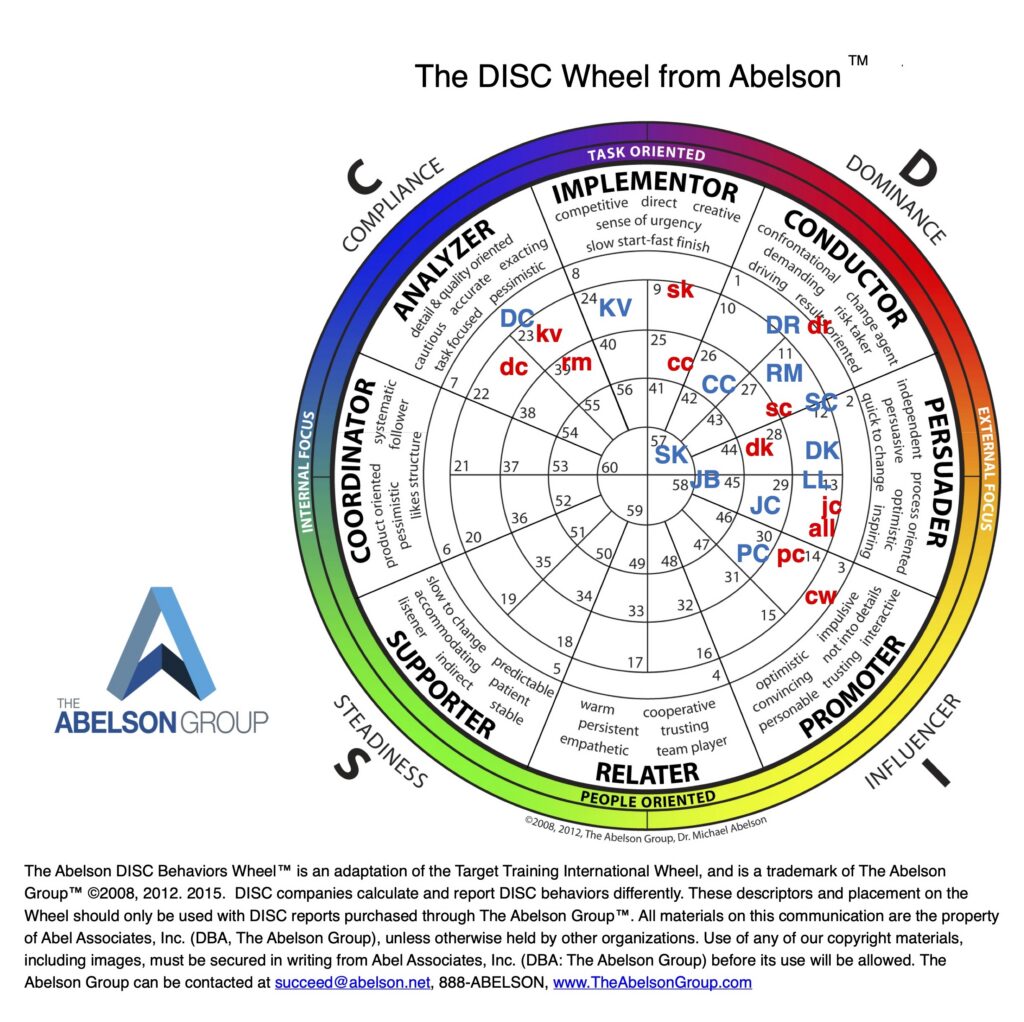
Using the Abelson DISC report, we help you understand how each person naturally communicates, makes decisions, handles pressure, and leads or supports. Then we map each person on the Abelson Behaviors Team Wheel so you can see strengths, gaps, and potential people conflict at a glance.

But here’s where most people stop short: they forget to ask why their team members show up every day.

That’s where Motivators come in.

DISC Tells You How They Work. Motivators Tell You Why.

You can’t get consistent performance if someone’s behavior fits the role but their motivation doesn’t.

Let’s say you’ve got a high S/C on your team—steady, methodical, great with details. Perfect for process work, right?

But if that same person scores low in the Utilitarian motivator—meaning they don’t care much about efficiency or ROI—you’re going to struggle if the job is framed around outcomes and speed.

You want to know:

  • Are they driven by results or relationships?
  • Do they light up when they get to learn and grow—or when they get to serve others?
  • Are they wired for independence, collaboration, impact, or recognition?

When you align both behaviors and motivations, you unlock a level of energy, efficiency, and clarity that changes everything. Tasks get done faster. Miscommunication drops. Friction disappears. People stop working harder and start working smarter, together.

Motivation = Efficiency Multiplier

Here’s what we do with high-performing teams:

  1. We plot all team members on the Abelson DISC behaviors Wheel and use that Wheel to better understand communication, decision-making, natural strengths, and many other behaviors.
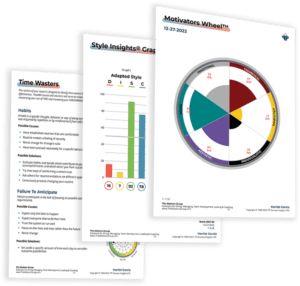
  2. We then plot them on the Abelson Motivators Wheel to reveal what fuels or drains each team member.
  3. We then overlay the insight from the Behaviors and Motivators Abelson Wheels to adjust roles, responsibilities, communication styles, and rewards.

Now you’re not just assigning tasks—you’re aligning people with purpose.

Ready to Optimize What You Already Have?

Before you post that next job ad, ask yourself: Am I fully utilizing the people I already pay?

Because in this market, efficiency wins. And the most effective teams are the ones where people are in the right roles, doing the right work, for the right reasons.

Let’s make sure your team is aligned to perform—not just busy.

📍 Learn how at www.theabelsongroup.com/teams we use DISC & Motivators via The Abelson Report to help companies thrive 

📞 Or schedule a quick discovery call to talk about your team.  We’ll show you why we were featured on the July 2024 issue of Manage HR Magazine as the top team building service provider in the country.

To better performance through better alignment,
Dr. A
Founder, The Abelson Group

Why Smart Teams Use DISC & Motivators to Perform at a Higher Level

Why Smart Teams Use DISC & Motivators to Perform at a Higher Level

Over the last 45+ years working with leaders and organizations across the globe, I’ve seen a common thread in underperforming teams: they have the skills, the experience, and even the ambition—but they don’t understand each other.

Great teams aren’t just built on talent. They’re built on clarity of behavior and alignment of motivation. That’s where the DISC and Motivators Assessments, used by The Abelson Group, makes all the difference.

Let’s talk about why this matters—and how it changes the game for any organization willing to look beyond the resume.

You’re Not Managing People. You’re Managing Patterns.

The real challenge in leading a team is not managing tasks—it’s managing behavioral patterns. Who communicates directly? Who avoids conflict? Who thrives in change? Who resists it?

Our version of the DISC Assessment captures both Natural and Adaptive behaviors—so you’re not just seeing how someone acts on a good day, but how they adjust under stress or pressure. That insight is gold when you’re trying to navigate deadlines, personality clashes, or high-stakes decisions.

When you combine that with Motivators, you now understand why someone acts the way they do. Are they driven by logic, loyalty, influence, innovation? You don’t have to guess anymore.

The DISC Wheel: A Snapshot of Team Dynamics

One of the most useful tools I use with teams is the Abelson DISC Behaviors Wheel. It allows you to visually place every team member on a single graphic, based on their dominant behavioral traits.

Why does this matter?

Because you can now see where your team is strong—and where you may have gaps. For example:

  • Too many High Ds? You’ve got energy and drive—but you might lack harmony or detail-orientation.
  • All High Cs? You’ve got precision—but may stall when it comes to fast decision-making or innovation.
  • Missing High Is? You may struggle with influence and group morale.

Once a team is placed on the wheel, patterns emerge. Leaders can realign responsibilities, identify who to coach differently, and—importantly—see where future hires should complement the current group.

The DISC Wheel makes the abstract visible, and in leadership, that’s a major advantage.

Why Motivators Matter Just as Much

Understanding behavior is only part of the equation. If you want to keep your people engaged and fulfilled, you need to understand what drives them.

Some team members are driven by recognition. Others by autonomystructureservice, or intellectual challenge. When those internal values are not acknowledged—or worse, are in conflict with how they’re being managed—people disengage.

Our Motivators Assessment allows you to align leadership, coaching, and even incentives with the unique inner drivers of each team member. This turns leadership into a strategic process, not a guessing game.

Conflict Doesn’t Have to Be Costly

Many organizations come to us because their team is experiencing conflict. What I always tell them is this: conflict is not the enemy—misunderstanding is.

When teams understand the behavioral and motivational profile of their teammates, conflict often turns from emotional reaction to professional dialogue.

Instead of “She’s just difficult,” we hear, “She’s a High C under stress and needs more data to feel confident.” That reframing alone can save projects, performance, and people.

The End Goal: Predictable, Sustainable Performance

Using DISC and Motivators doesn’t just make teams feel better—it makes them perform better. Consistently.

You can:

  • Communicate more clearly
  • Assign responsibilities more strategically
  • Create development plans that actually stick
  • Retain the right people
  • Hire more intelligently

And you can do all of this with less trial and error.

Final Thought

People are the most valuable—and most complex—part of any organization. If you don’t understand how they behave and what drives them, you’re flying blind.

At The Abelson Group, we’ve spent decades using and showing our clients how to use tools that don’t just describe people—they equip leaders to get results through people.

If you’re serious about building a team that doesn’t just function—but flourishes—DISC and Motivators will give you the roadmap and we will be your guide.

Let us help you make the invisible visible and the impossible doable!

Mastering and Defeating The 5 Dysfunctions of a Team

Mastering and Defeating The 5 Dysfunctions of a Team

Research and experience tells us effective teams are much better performers than are individuals.  When things are chaotic, in constant flux, or stressful, high performing teams are that much more important.  When led effectively, the team dynamic helps calm things down, helps people focus on doing what they are best at accomplishing, and leads to a much better outcome or solution.

read more…
A System For Winning The Super Bowl & At Life

A System For Winning The Super Bowl & At Life

How do great poker players win most of the time?  They have a system!

How do great sports teams create a dynasty?  They have a system!

How do successful people keep being successful? They have a system!

YOU have a system for winning within YOUR grasp!!!

read more…

Pin It on Pinterest